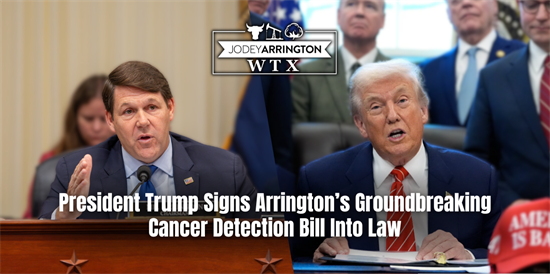
Washington, D.C. – President Trump has signed into law H.R. 7148, a legislative package that includes House Budget Chairman Jodey Arrington’s (TX-19) groundbreaking cancer detection legislation, the Nancy Gardner Sewell Medicare Multi-Cancer Early Detection Screening Coverage Act.
This landmark new law represents a major step forward in the fight against cancer by ensuring that Medicare beneficiaries gain timely access to multi-cancer early detection (MCED) tests once they are approved by the Food and Drug Administration. Early detection saves lives, and this legislation will help ensure seniors are not left behind as lifesaving medical innovation advances.
The bill, led by Chairman Arrington and his Democratic co-lead Rep. Terri Sewell (AL-07), received overwhelming bipartisan support in Congress and was backed by a broad coalition of advocates and outside groups across the country - including Dallas Cowboys quarterback Dak Prescott.
“I, alongside my colleague Rep. Terri Sewell, are incredibly proud to announce President Trump has signed into law our bipartisan Nancy Gardner Sewell Medicare Multi-Cancer Early Detection Screening Coverage Act,” said Chairman Arrington. “This critical law will give seniors access to groundbreaking innovation that will transform the way we treat, diagnose, and prevent cancer. With over 338 House cosponsors, 60 Senate cosponsors, 500 supporting organizations, and even Dallas Cowboys QB Dak Prescott, together, we are unleashing the power of early detection and saving millions of lives.”
“It's official! On this World Cancer Day, I'm excited to announce that the Nancy Gardner Sewell Multi-Cancer Early Detection Act has been signed into law,” said Rep. Sewell. “I join millions of Americans in celebrating this historic victory which will help transform the way we detect, diagnose, and treat cancer for seniors all across America. We did it, Mommy.”
Honoring Nancy Gardner Sewell
Arrington named the legislation in honor of the mother of his Democrat colleague, Rep. Terri Sewell, who passed away from pancreatic cancer in 2021. Last year, the legislation was passed out of the Ways & Means Committee by a unanimous, bipartisan vote of 38-0.
Dallas Cowboys
In 2023, Dallas Cowboys Quarterback Dak Prescott paid for the entire team’s staff to receive MCED screening, leading to the early detection of Cowboy’s Vice President of Communications Tad Carper’s cancer in his tonsils – detecting his cancer before any symptoms had appeared. Carper credits the screening with saving his life, and has since advocated for increased accessibility, as seen in his open-letter to Chairman Arrington from November 22, 2024.
“This is critical for so many across our nation. A true game-changing life-saver. I was lucky enough to benefit from the access Dak provided. It shouldn’t need to come to that, though,” said Tad Carper, Vice President of Communications for the Dallas Cowboys. “You have to step back and ask, why in the world would this not be something that is easily and affordably available to everyone? What are our priorities? Isn’t this also creating a great financial savings for all compared to the alternative of catching things late in the game? It is inexcusable for this to be available, yet hitting roadblocks and delays. I applaud the efforts currently being made to save lives and the work being done by leaders like Representative Arrington and others to focus on what is needed.”
Dak Prescott’s mother, Peggy Prescott, passed away in 2013 from colon cancer that was not diagnosed until it had progressed to stage 4. If it had been available, MCED screening could have potentially saved her life.
“If early detection was easy and available, my mother and so many others would still be alive,” said Dak Prescott, Quarterback of the Dallas Cowboys. “The science and technology exist right now to dramatically reduce the impact of cancer and change the story of countless people and families for generations to come. We need this now. There is no acceptable reason for delay. This is literally about life and death, like it was for Tad.”
Coalition Support
“With the signing of the MCED Screening Coverage Act, we are opening the door to a new era in how cancer is detected and ultimately prevented,” said Jody Hoyos, CEO of the Prevent Cancer Foundation. “This law aligns our health care system with the pace of scientific innovation and brings us one step closer to a future where more cancers are found earlier—when treatment is more effective and lives can be saved.”
“ACS CAN is grateful that Congress worked together to bring these cancer-fighting provisions across the finish line,” said Shane Jacobson, CEO of the American Cancer Society and American Cancer Society Cancer Action Network (ACS CAN). “They represent real progress for patients, survivors and families facing cancer every day. We thank all members, especially House and Senate appropriators, for recognizing the urgency of sustained investment in cancer research, prevention and access to care. We are also deeply grateful to the thousands of ACS CAN volunteers from across the country who worked tirelessly to share their stories. These volunteers collectively sent more than 126,000 messages to lawmakers to help make these victories possible. Their voices, persistence and commitment were essential, and their advocacy continues to drive the progress needed to end cancer as we know it, for everyone.”
“It’s a historic day in the fight against cancer. We are deeply grateful to lawmakers, especially Representatives Terri Sewell (D-AL) and Jodey Arrington (R-TX), patient advocates, and all those who fought tirelessly for this groundbreaking legislation,” said Kevin Conroy, chairman and CEO of Exact Sciences. “Most importantly, we are thrilled for the countless individuals whose lives will be impacted by these tests, potentially giving them more opportunities to celebrate birthdays, anniversaries, and precious moments with their loved ones.”
Laura Crandall Brown Foundation said, “Today changes what’s possible in cancer detection. Years of momentum, overwhelming stakeholder support, and bipartisan leadership led to this moment. The MCED Act has passed, marking one of the most significant cancer policy advances in years. Thank you Rep. Terri Sewell!”
Cancer Support Community said, “We are proud to have stood with 550+ advocacy organizations calling for passage of the MCED Act. Today, the cancer community won.”
Association of Cancer Care Centers said, “ACCC is proud to have stood with 550+ advocacy organizations calling for passage of the MCED Act. This week, with the passage of this legislation providing for Medicare coverage of multi-cancer early detection tests once they are FDA approved, the cancer community won. Thank you so much Speaker Mike Johnson; Representative Hakeen Jeffries; Representative Jodey Arrington; Representative Terri Sewell; Representative Richard Hudson; Representative Raul Ruiz, MD; Representative Mariannette Miller-Meeks, MD; Representative Robin Kelly; Senate Majority Leader John Thune; Senator Chuck Schumer; Senator Mike Crapo; Senator Michael Bennet; Senator Tim Scott; and Senator Ron Wyden.”
IDT President Ajay Gannerkote says, “IDT has been a driving force in supporting the development of multi‑cancer early detection (MCED) and minimal residual disease (MRD) technologies, leveraging our bespoke manufacturing and NGS expertise to advance precision oncology research worldwide. NGS has already reshaped how cancer is studied and detected, and MCED and MRD technologies will further expand these capabilities. With this legislation, the industry’s need to partner with manufacturers at the forefront of innovation, who have specialized, high‑throughput production, like IDT, has never been clearer—we are uniquely positioned to help scale and accelerate the science that underpins the future of cancer detection. Many of the world’s leaders developing MCED research programs already rely on IDT today to support their assay development and innovation, and we are ready to help them build this next wave of precision oncology research.”
GO2 for Lung Cancer said, “We are proud to have stood with 550+ advocacy organizations in support of the MCED Act. Today, the cancer community won.”
National Grange said, “The MCED Act is a major win for rural communities! THANK YOU.”
Palmetto Health Collective said, “A huge step forward for cancer patients and families nationwide: the MCED Act has passed. Early detection just became a national priority.”
Letters of Support for H.R. 842 from the following organizations:
Background:
The Nancy Gardner Sewell Medicare Multi-Cancer Early Detection Screening Coverage Act would increase seniors’ timely access to multi-cancer early detection technology by creating a pathway to Medicare coverage. This bill will allow for Medicare coverage of MCED screenings once they are approved by the Food and Drug Administration. These new MCED screening tools will complement existing screening and dramatically improve our nation’s cancer early detection capabilities. Currently, we are only able to commonly screen for five cancers and just 14% of cancers are found through screenings. These tools introduce a significant shift in the cancer screening landscape. Ensuring seniors have timely access is essential since age is the primary risk factor for cancer and more than 70% of cancer diagnoses are in the Medicare population. This legislation will open the door to a new era of detecting and treating cancer while ensuring that our most vulnerable citizens are not left behind.
Specifically, the legislation would:
-
Create the authority for CMS to cover blood-based MCED tests and future test methods once approved by the FDA and shown to have clinical benefit.
-
Maintain CMS’ authority to use an evidence-based process to determine coverage parameters for these new tests.
-
Clarify that (1) these new tools will complement, not replace, existing screenings and coverage and (2) cost sharing will not be impacted.