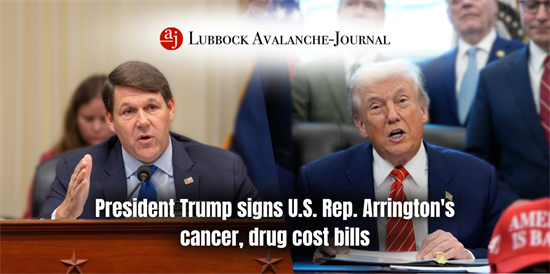
President Trump signs U.S. Rep. Arrington's cancer, drug cost bills
By Mateo Rosiles
Feb. 11, 2026
AS SEE IN THE LUBBOCK AVALANCHE-JOURNAL
Several bills championed by U.S. Rep. Jodey Arrington related to
early cancer detection and lowering drug costs were recently signed into law by the president.
Earlier this month, President Donald Trump signed into law several bills that Arrington, a Lubbock Republican, helped author — one of which has been a long time in the making.
Here's what the bills are and what they are set to do.
Arrington's bipartisan early cancer detection bill becomes law
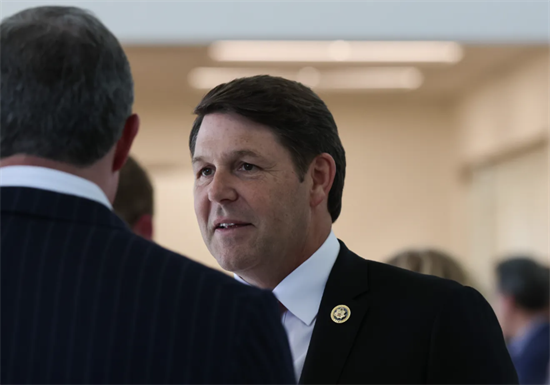
U.S. Rep. Jodey Arrington, R-TX, talks to Texas Tech System Board of Regents Chairman Cody Campbell at the U.S.
Department of Agriculture Agricultural Marketing Service Cotton Classification Complex on April 16, 2025 in Lubbock, TX.
Mateo Rosiles/Avalanche-Journal |
Arrington, along with U.S. Rep. Terri Sewell, D-Alabama, authored the Nancy Gardner Sewell Medicare Multi-Cancer Early Detection Screening Coverage Act (H.R.842).
The bill was named after Sewell's mother, who passed away from pancreatic cancer in 2021.
According to previous Avalanche-Journal reporting, versions of this bill were first introduced in 2020, then again in 2021 and in 2023.
Nov. 11, 2025; Tuscaloosa, Alabama, USA; U.S. Representative Terri Sewell speaks at the Veterans Day observance at
Veterans Memorial Park. Gary Cosby Jr. - Tuscaloosa News |
However, in the fall of 2025, when it was introduced, it received unanimous bipartisan support in the U.S. House Ways and Means Committee. The bill even garnered national support, including from Dak Prescott, quarterback for the NFL's Dallas Cowboys.
According to Arrington's team, the legislation will give senior citizens access to groundbreaking innovation that is set to transform how cancer is detected, diagnosed, and treated.
Specifically, the legislation would:
- Create the authority for CMS to cover blood-based MCED tests and future test methods once approved by the FDA and shown to have clinical benefit.
- Maintain CMS’ authority to use an evidence-based process to determine coverage parameters for these new tests.
- Clarify that these new tools will complement, not replace, existing screenings and coverage and cost sharing will not be impacted.
After the signing of the bill on Feb. 4 — World Cancer Day — both Arrington and Sewell released statements expressing their elation.
“This critical law will give seniors access to groundbreaking innovation that will transform the way we treat, diagnose, and prevent cancer," Arrington said. "With over 338 House cosponsors, 60 Senate cosponsors, 500 supporting organizations, and even Dallas Cowboys QB Dak Prescott, together, we are unleashing the power of early detection and saving millions of lives."
“I join millions of Americans in celebrating this historic victory which will help transform the way we detect, diagnose, and treat cancer for seniors all across America," Sewell said."We did it, Mommy.”
President Trump signs Arrington's bill to regulate PBMs, lower drug costs
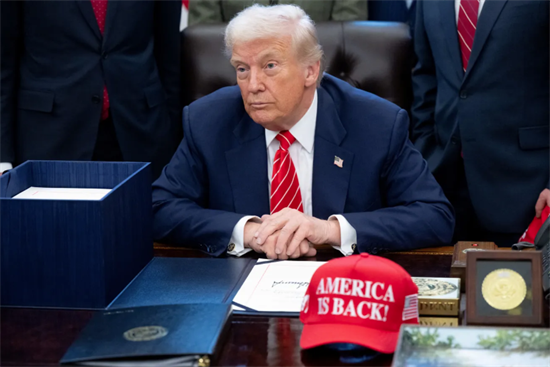
President Donald Trump is pictured speaking with reporters at the White House after signing a funding bill on Feb. 3, 2026.
SAUL LOEB, AFP Via Getty Images |
Arrington's Better Deals and Lower Prices Act (HR 7148) was signed into law on Jan. 3, 2026.
According to Arrington's team, most companies do not have the resources to negotiate back and forth with drug manufacturers on the cost and quantity of the drugs they require for their employees ,leading them to utilize pharmacy benefit managers (PBM).
From there, the three largest PBMs have grown to control 90% of the market, meaning companies can't act as rational consumers and compare PBM net price data across the market, or "shop around."
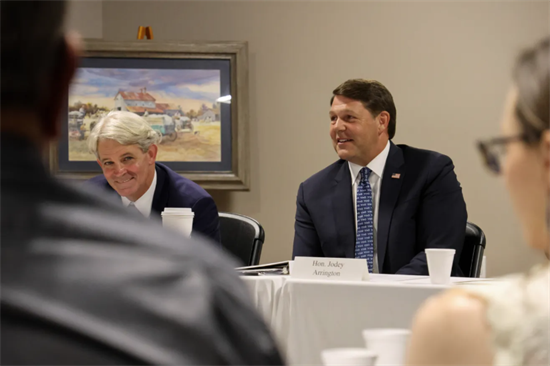
U.S. Rep. Jodey Arrington smiles at a roundtable discussion with local and state leaders to discuss wins and impact of the
One Big Beautiful Bill, which Arrington helped author on July 10, 2025 in Lubbock, Texas. President Trump signed the bill
on July 4, 2025. Mateo Rosiles/Avalanche-Journal |
Additionally, according to Arrington, Americans with employer-sponsored insurance — roughly 160,000,000 — are paying higher premiums than they need to.
Arrington said the new law would increase transparency from PBMs on net price data for all drugs, regardless of class, to employers that request it.
“The result? Lower prices, lower premiums, and a system that works for both patients and taxpayers," Arrington said. “I’m proud to have led on these commonsense reforms that will drive down health care costs and deliver better deals for hardworking American families.”