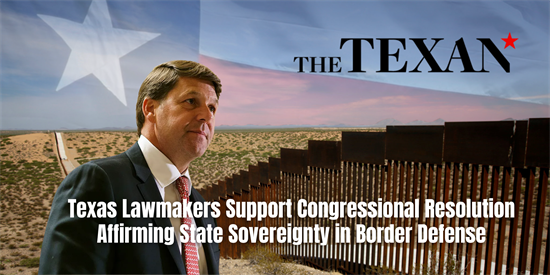
Texas Lawmakers Support Congressional Resolution Affirming State Sovereignty in Border Defense
Twenty-five Texas lawmakers signed a letter to the U.S. House requesting that the resolution be passed.
By Mary Elise O'Bar
April 8, 2026
AS SEEN IN THE TEXAN
A resolution re-affirming states’ constitutional right to defend their borders in cases of invasion was introduced in Congress to act as future supporting material if the issue is one day taken to the Supreme Court of the United States (SCOTUS).
Congressman Jodey Arrington (R-TX-19), who is currently serving his fifth and last term due to his impending retirement, has collected support from 25 Texas state lawmakers and several other state leaders for his House Resolution 50.
Arrington said the resolution uses Texas’ and other border states’ experiences under former President Joe Biden’s administration as “context,” describing Biden’s policies to The Texan on Tuesday as causing a real “invasion of people, drugs, and all kinds of criminal elements.”
He noted that such a resolution wouldn’t establish a new law per se, but “affirms what the Constitution says about the sovereign right of every state to defend itself in the circumstance of an invasion.”
H. Res. 50 was introduced in the 118th Congress before Arrington re-introduced it in 2025 during the 119th Congress. During its first introduction, it was supported by every member of Texas’ U.S. House delegation and over 60 Congress members in total.
Arrington said that while he hopes it doesn’t occur, a future “invasion and endangerment of the citizens of a number of sovereign states” under another Democratic president through a return to Biden-era border policies is possible, and if or when that happens, he believes that SCOTUS will be faced with making a decision on states’ authority in the issue.
“There will be a case that will go all the way to the Supreme Court, and the Supreme Court will then look for definitional clarity from Congress about what an invasion is and about what constitutes imminent danger for states,” Arrington asserted.
“So to elucidate that and to bring greater clarity and congressional intent, it's important that the that the United States House and Republicans who are leading the House pass this resolution to inform what will be, no doubt … a case that will be the precedent for decades, if not centuries, to come.”
Among the various challenges that Texas faced in its attempt to address the heightened border crisis during the Biden administration was a legal challenge from the U.S. Department of Justice (DOJ), which sued the state over legislation passed in 2023 that prohibited any foreign national from illegally entering the state between ports of entry and in violation of federal law. Once Trump took office, the DOJ withdrew its opposition to the case.
Arrington partially blamed the “lack of clarity on the constitutional right of each state” for the DOJ being allowed to “obstruct and harass” Texas seeking a closed border.
Arrington said that if states’ sovereign authority in this issue were fully recognized in practice, states like “Texas would have been able to put up the barriers along the border” under the Biden administration. SCOTUS was involved in the Biden DOJ’s litigation against Texas over its placement of razor wire barriers to secure its southern border with Mexico.
In January 2024, SCOTUS issued an order that lifted an injunction imposed by the U.S. 5th Circuit in December 2023 that had prevented the Biden administration from removing the state’s barriers.
“We don't want to have any question whatsoever, any hesitation whatsoever for every sovereign state that they don't have to be passive victims of a failed federal government. They can engage and they can exercise that sovereign constitutional right to protect their citizens,” Arrington said.
John Yoo, who served as deputy assistant attorney general for the Office of Legal Counsel under former President George W. Bush, assisted Arrington in crafting this resolution to serve as supporting material for a future SCOTUS case on the issue.
Yoo told The Texan in a written statement about H. Res. 50 on Tuesday, “The Constitution, as interpreted by the Supreme Court, forbids states from interfering with the federal government’s monopoly over our territorial sovereignty.”
“But the House of Representatives could make its own findings of fact that failures at the border rose to the level of an ‘imminent danger’ that would justify a state’s exercise of self-defense. Such a set of findings might bolster Texas’s case in the courts as well as its political case to the public,” he added.
In a
letter obtained by The Texan, lawmakers who support the resolution include 24 Republican members of the Texas House of Representatives and one state Sen. Adam Hinojosa (R-Corpus Christi). Additionally, Texas GOP Chairman Abraham George signed on, as did all members of the Texas Senate Republican Executive Committee.
The letter was addressed to the U.S. House of Representatives.
Leon Rios, Director of the Border Security Operations Center at the Texas Department of Public Safety, was included in the list of supporters, as was Mark Morgan, the former acting commissioner of U.S. Customs and Border Protection and former chief of the U.S. Border Patrol
The letter was spearheaded by the Texas Public Policy Foundation (TPPF), with its opening statement and pledge of support for the resolution written by TPPF CEO Greg Sindelar.
The letter asserted that the resolution would not “diminish federal authority,” but that it instead “clarifies constitutional reality. It affirms that states possess inherent sovereign authority to act in defense of their territory and people.”
“For these reasons, we respectfully encourage your support of H.Res.50. Doing so reaffirms the constitutional structure the Framers designed—one that preserves both national security and the sovereign capacity of states to defend themselves when necessary,” the letter concludes.